How to Spot Crypto Scams in Nigeria
Fake celebrity videos, "200% in 30 days" schemes and online lovers who need money: how crypto scams in Nigeria work, and how to check it's really Palremit.
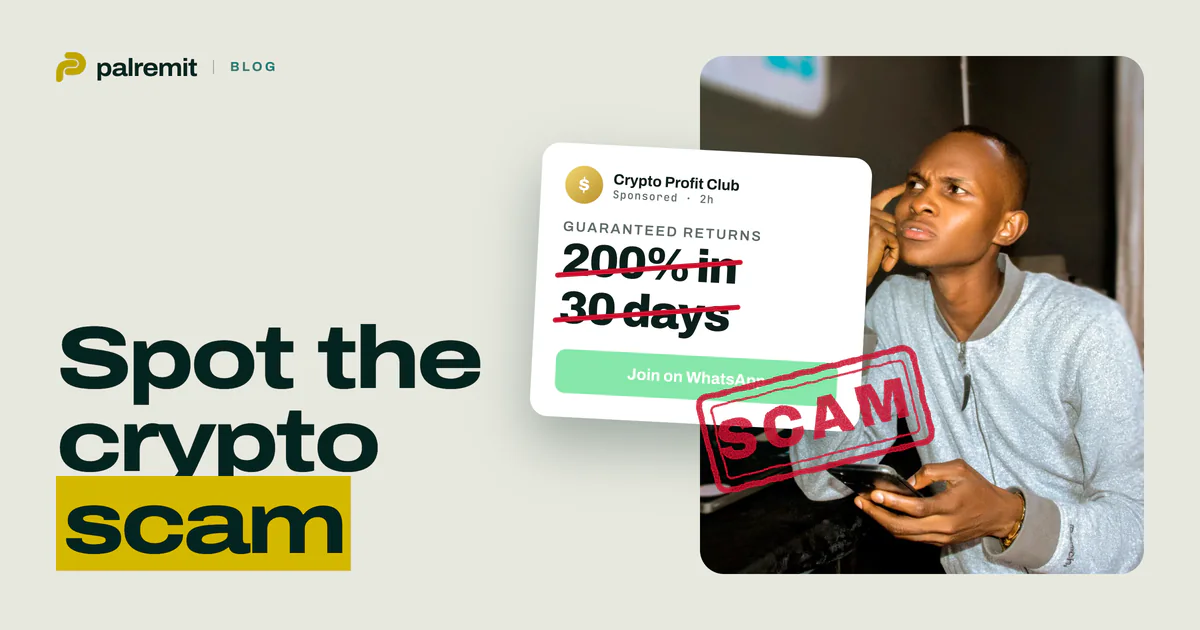
A crypto scam promises you big, safe returns or asks you to send money to someone you have never met. Then the money is gone. If an offer guarantees high returns with no risk, Nigeria's SEC says it is almost always a scam.
The losses are large. In October 2025, an SEC official said Nigerians had lost ₦300.2 billion to Ponzi schemes in recent years. That figure leaves out CBEX, which collapsed in 2025.
Here's how the main scams work, the red flags to look for, and how to check that a message really comes from Palremit.
Last checked: 14 November 2026.
1. The "guaranteed returns" scheme
How it works: a platform promises a high, fixed return on your naira or crypto. Early members get paid with money from new members, so it seems to work for a while. Then withdrawals stop, the operators blame a "hack", and the money is gone.
A real example: in January 2026, the SEC's Director-General met the Inspector-General of Police about these schemes. He warned that they "promise absurd returns such as 200% in 30 days." That same month, the EFCC said the operator of Polyfarm had taken investors' money for himself. He had blamed a hack, but the EFCC found no sign of one. Polyfarm was promoted on WhatsApp, X and Telegram, and at seminars in Lagos, Abuja, Kaduna and Port Harcourt.
Red flags:
- Guaranteed high returns with "no risk".
- A platform that isn't registered with the SEC.
- Contact only through WhatsApp or Telegram, with no office address you can check.
- Sudden "hacks" or problems when you try to withdraw.
2. The fake celebrity video
How it works: you see an ad on Facebook, Instagram or Telegram. A famous Nigerian appears to recommend an investment platform. The video was faked with AI. The SEC has warned that scammers make fake videos of politicians, celebrities and media figures to make bad platforms look real. In 2026, doctored videos of business leaders, including former First Bank chair Ibukun Awosika, were used in Facebook ads for fake investments.
Red flags:
- A famous person "revealing" a way to get rich, in an ad.
- A link that goes to a sign-up page, not to the person's verified account or a news site.
- An offer that uses a celebrity's name instead of an SEC registration number.
3. The romance scam
How it works: someone you meet online builds a relationship over weeks. They can never meet you in person. Then they need money, or they offer to help you start "investing" in crypto. Some scam networks are run like businesses. In February 2026, police arrested seven people in Agbor, Delta State. Police said the group's leader bought about 500 social media accounts and used fake profiles posing as crypto traders.
Red flags:
- They always have a reason they can't meet you.
- They want to move the chat off the dating site or app.
- They ask for money, or for payment by crypto, gift cards or wire transfer.
- They offer to teach you crypto investing.
Tip: do a reverse image search of their profile photos. Scammers often use pictures taken from other people.
Red-flags checklist
Stop and check if you see any of these:
- A promise of guaranteed or very high returns, such as "200% in 30 days".
- "No risk", or a celebrity endorsement in an ad.
- No SEC registration, or a registration number that doesn't match the SEC's list.
- Contact only on WhatsApp or Telegram, with no office address.
- Someone you've never met asking for money, crypto or gift cards.
- A sudden "hack" that stops you withdrawing.
- Someone asking for your PIN, password or one-time codes.
How to check a platform
- Check SEC registration. Look the company up on the SEC Nigeria website. Make sure the registration number they give you matches.
- Search the name with "scam" or "SEC warning". The SEC warns the public about schemes that aren't registered.
- Never share your BVN, PIN, password or one-time codes in a chat.
- If you've been scammed, stop sending money. Save your chats and transaction details. Report it to the EFCC and the police, and tell your bank or app straight away.
Is this really Palremit?
Scammers sometimes pretend to be Palremit. Here is how Palremit really contacts you, from our Help Center.
How Palremit contacts you:
- Email: transactional emails come when you sign up, ask for a verification code or make a transaction. They show as sent from "Palremit". Marketing emails come only if you agreed to them.
- Social media: our accounts are @palremit on X, Facebook, Instagram, TikTok and LinkedIn. Only trust the verified accounts.
- In-app live chat: our support team answers in the app, 24/7.
- Support email: [email protected].
What Palremit never does:
- Palremit will never DM you first on social media.
- Palremit will never ask for your account details or personal information in a DM.
- Keep your PIN, password and one-time codes to yourself. The Help Center tells you to protect them. Anyone who asks for them is a red flag.
- Palremit is a payments app, not an investment scheme. We don't promise returns.
How to check: got a message, call or DM that says it's from Palremit? Don't reply to it. Open the Palremit app and ask in the live chat. It runs 24/7.
Keep your account safe
- Turn on biometric login and keep your transaction PIN private. Our guide to stopping SIM-swap fraud explains how.
- Before you send USDT to any address, check the network. Our stablecoins guide explains why.
- Sending money home for the holidays? Read how to send safely for December. Fake "family emergency" messages are common at that time of year.
FAQs
How do I know if a crypto investment is a scam? Guaranteed high returns, "no risk", celebrity ads and no SEC registration are the main warning signs. The SEC says no-risk, guaranteed-return offers are almost always scams.
Does Palremit offer investments or returns? No. Palremit is a payments app for sending, receiving, swapping and spending money. It doesn't promise returns.
Will Palremit ever message me first on social media? No. Palremit will never DM you first or ask for your account details. If in doubt, ask in the in-app live chat.
Where do I report a scam in Nigeria? Report it to the EFCC and the police. Tell your bank or app straight away so they can try to stop further losses.
Sources
- Techloy, 15 January 2026: Why Nigeria's crypto investment scam problem is forcing regulators to call in the police
- Nairametrics, 31 January 2026: Polyfarm crypto scam: NSCDC nabs operator accused of wiping investors' funds
- Technext, 30 October 2025: Nigerians lost N300.2 billion to Ponzi schemes in recent years, SEC
- CryptoRank (from Cryptopolitan), 29 September 2025: Nigeria's SEC warns of AI deepfakes pushing fraudulent investment schemes
- Nairametrics, 5 May 2026: Nairametrics disclaims fake AI videos impersonating founder, warns investors
- THISDAY, 6 February 2026: Police bust online investment scam syndicate, arrest seven in Delta raid
- US Federal Trade Commission, August 2022: What to know about romance scams
- Palremit Help Center: How does Palremit reach out to me?
- Palremit Help Center: How do I contact Palremit?
This article explains how common scams work. It is not financial or legal advice. Palremit Inc. is a Money Services Business registered with FinCEN in the United States.